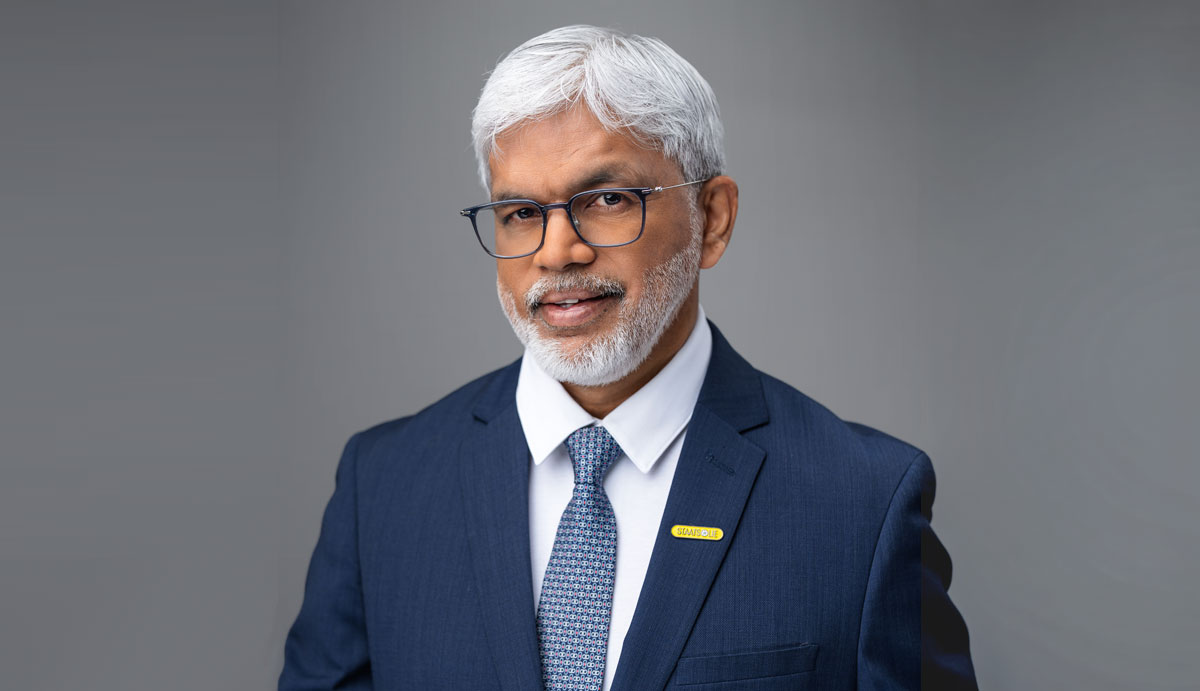
15 Apr Interview with Mr. Annand Jagesar, CEO & Managing Director, Staatsolie Maatschappij Suriname N.V.
Staatsolie has consistently expanded its strategic role in Suriname’s economy. Which elements of this integrated model have proven most critical to Staatsolie’s long-term resilience and where do you see the next major capability upgrade?
Staatsolie’s long‑term resilience is driven by a balanced portfolio in which all elements are chosen because they contribute. Exploration and production is a high‑risk, high‑reward business, with risks related to reservoir performance, reserve replacement and oil price volatility. Power generation and retail provide more stable income streams, with lower margins but greater predictability. Together, this balance has proven critical over time.
Looking ahead, the next phase will largely be more of the same, but with increased complexity and greater attention to sustainability. Staatsolie will move from onshore into offshore activities, as a non‑operator. We aspire to become a shallow‑water operator in the future by learning from our partners and our strong onshore track record provides a solid basis for success. Sustainability will also play a growing role, particularly through the execution of solar projects.
The expansion of the Tout Lui Faut refinery, which doubled capacity and strengthened domestic fuel security, marked one of Staatsolie’s most complex infrastructure milestones. How did executing a refinery-scale infrastructure project shape how Staatsolie plans and sequences today’s offshore and midstream developments?
Offshore production installations are process installations that operate in many ways similar to a refinery. The experience gained from executing the approximately $1 billion Tout Lui Faut refinery project, combined with our long‑standing process knowledge from onshore oilfields and more than ten years of operating the refinery, has been highly valuable.
This combination of project execution experience and operational expertise is crucial for understanding offshore processes and enables Staatsolie to effectively supervise developments in its roles as regulator and contracting party.
With the Final Investment Decision for Block 58’s GranMorgu project and first oil targeted for around 2028, Suriname’s offshore sector is entering a decisive execution phase. What are the top execution priorities Staatsolie is focused on today to ensure GranMorgu sets a benchmark for future offshore projects?
The FID was announced on October 1st, 2024. So we are already 20+ months into the project. It is running well, is still on time and within budget. Key success factors include copying the successful approach in previous projects executed in Guyana. With TotalEnergies as operator, we have a world‑class implementer of FPSO projects. The operator also secured key contracts early to mitigate pricing risks. Staatsolie contributes through close supervision of activities and we are already engaging with TotalEnergies on options to prolong plateau production, which would be beneficial for all parties involved.
Where does the project currently stand and what milestones over the next 12–24 months are most critical?
The project is progressing along its planned execution path. As with any large offshore development, there are critical path items that are closely monitored in terms of manufacturing and delivery. These include key components such as wellheads and gas compressors. At the same time, further optimization of government permitting processes in Suriname remains an important milestone to support timely execution over the next 12–24 months.
Staatsolie’s decision to secure up to a 20% stake in GranMorgu supported by a substantial bond issuance and external financing signals a strategy to balance national participation with financial discipline. What principles guide your capital allocation and risk management as Staatsolie scales offshore participation?
We have an elaborate risk management system in place, with a clearly defined risk appetite and value‑at‑risk framework. Within those boundaries, we focus on creating shareholder value. The GranMorgu financing is significant and sits at the outer limits of our capability, which is why risk mitigation is essential.
Mitigations include a price hedging program, while participation in a gold mining project also provides a natural hedge. In addition, several project characteristics make GranMorgu attractive from a risk perspective, including a world‑class developer in TotalEnergies, early contract lock‑ins to reduce pricing risk, and a low cost per barrel.
What makes Staatsolie an attractive partner for international financiers and operators and what does the company expect in return?
Track record is the key factor! Staatsolie has been financing itself since its early days and has never missed a repayment or interest payment. We report on time and engage with lenders strictly in line with our financing contracts.
There are, of course, additional contributing factors, including the quality of the project itself and the presence of a world‑class developer. What we expect in return is the continuation of these strong relationships and the creation of a platform that allows us to finance other projects that will undoubtedly follow in the future.
Beyond Block 58, Staatsolie continues to broaden the offshore portfolio through new PSCs and advancing gas development opportunities, positioning the country for a diversified energy future. How do oil, gas and sustainability objectives fit together in shaping a balanced, diversified portfolio that supports both near-term monetization and long-term national capacity?
Our sustainability objective is to reduce the CO₂ intensity of our operations. This is achieved, among other things, by using emissions from our operations in a productive manner instead of flaring and by avoiding methane leakage. Another key element is designing each project to be a low emitter from the outset.
Together with our contract parties, we are investing significant amounts in the GranMorgu project to lower emissions. The project is designed to produce around 35lbs of CO₂ per barrel, compared to an industry average of approximately 52lbs per barrel. In parallel, we are working to convert power generation in Suriname to a gas‑based system. Finally, we are investing in renewable energy projects such as solar, and contributing to nature‑based solutions initiatives.
As global energy majors deepen their presence in Suriname’s basin, Staatsolie’s role increasingly extends beyond participation to setting standards for partnerships, local content, and sector governance.
Looking 3-5 years ahead, what would define success for Staatsolie’s legacy in shaping a world-class energy sector that delivers lasting value for Suriname?
Keeping things simple but effective. Staatsolie focuses on effective oversight of operations and properly executing its fiduciary duties. Those duties include securing the greatest overall benefits for Suriname. Achieving that outcome depends on the levers already mentioned: strong partnerships, clear standards, effective governance and disciplined execution.
Suriname is at the beginning of a strong economic development cycle, with significant opportunities offshore. Investors who have worked with Staatsolie value our professional conduct and the way we support exploration through our knowledge and experience. Together, we can be highly successful. Staatsolie is open for business.
Sorry, the comment form is closed at this time.